
Adventures in GEMBA Flex
Wherein I muse for your amusement

This year, INSEAD launched a GEMBA Flex program in which participants take some courses face-to-face and others online. And if you are wondering, if the price point is the same, indeed it is. I would have charged higher for the flexibility the format affords, but of course, that depends on the elasticity of demand.
Demand was higher than anticipated, and the initial cohort consists of 60 students in two sections. I was asked to teach in it. I promptly said no - this is my iron rule for teaching over Zoom. Pressure was brought to bear from higher-ups and I folded. More like a putty rule I guess.
I teach every Wednesday and Friday, 3-5 pm and 6:30-8:30 pm, for four weeks in a row. Each session is two hours instead of four. The technology is nearly flawless with two giant screens, multiple machines, a camera at the correct height, and a separate smart board that shows the chat. The only glitch is that on Zoom, the participants’ faces bounce around the two screens, which annoys me no end.
Preparing the Course
In my last GEMBA run, the variance in all my group assignments collapsed to zero. Earlier, participants would tackle a problem from multiple perspectives, bringing their varied experiences to bear. Not only that, at least one group member would be from a related sector, and with assignments on oil, aluminum, and Apple Watch pricing, it would also be an intra-group learning opportunity. But now, hello LLM wizard! Flawless submissions with zero variation.
I imagined a world where I used an LLM to write assignments, students used LLMs to answer them, and then I used an LLM to grade them. I felt sad and counted the years till I retire. Most of my colleagues feel that all other disciplines and content will be replaced by AI, just not theirs. Good coping mechanism!
In any case, I rewrote all assignments assuming everyone would invoke Claude or one of its close cousins. In fact, groups are explicitly required to use an LLM to download data, do the analyses, and answer the questions.
Hiccups immediately. Some countries block access to the US models; some require subscriptions (free versions are limited and not up to the task); and some models are less capable (I am looking at you, Gemini). I hoped that they would resort to VPNs and DeepSeek, and heed my warnings about Gemini. But eventually, I had to upload the data. Remains a work-in-progress.
Time
When I teach face-to-face, I often run over by 10-15 minutes. Rarely does anyone complain. After all, postponing beer consumption (or working on the next assignment) by 10 minutes is hardly a big sacrifice. Or if they do complain, they do so in silence, testifying to their character. For GEMBA Flex, it dawned on me later that this crowd has places to be and people to see, so exceeding allotted time is a strict no-no. As a good Bayesian, I have updated my beliefs and adjusted behavior.
I also go through content more slowly and am covering less material. This bothers me. The world is getting more complex and infinitely more interesting, and I love showing the class how economic tools, developed over the last 100 years and more, remain essential. Every class, I have some cool backup slides in my pocket (actually, my USB drive), but that is where they remain.
In the first session, I planned to include some content on Jevons’ paradox to talk about the concept of elasticity. Anyone and their uncle who has read posts by OpenAI, World Economic Forum, or McKinsey would have encountered this 150-year-old idea. But time constraints meant I never got to it - a pity because it is one of the most useful ideas for thinking about AI, often invoked but frequently misunderstood. So, time to flex and show what they missed.1
Jevons Paradox
William Stanley Jevons, economist, mathematician, and logician, wrote in the age of steam, when Britain was still working through the consequences of coal-powered industrialization, one of history’s great general-purpose technologies.

Britain, he observed, was becoming much better at using coal. Steam engines were becoming more efficient. A given ton of coal could now produce more useful work. Surely that should reduce the amount of coal Britain needed? But Jevons argued that greater efficiency made coal-powered activity cheaper. By making steam power economical for massive new works (textiles, shipping, iron), efficiency improvements unlocked latent industrial demand that was previously cost-prohibitive. Paradoxically, efficiency did not conserve coal; by raising demand for coal, it increased consumption and made coal more central to the economy.
The same phenomenon shows up in LED lighting. LEDs, which became commercially viable in the 1990s, use less than 1% of the energy of a Victorian gas lamp. And they are 75% to 90% more energy-efficient than traditional incandescent bulbs. People expected that the adoption of LED lights would lead to energy savings, reduced light pollution, and, eventually, even lower CO2 emissions. But Jevons’ paradox showed up again. Yes, the direct effect reduced energy use. But cities and municipalities expanded street lighting, we started using lights for aesthetic displays and massive billboards, and even households and offices used the money they saved by keeping lights on longer (called the burn time rebound), and for new uses (called the luminosity rebound), such as buying Christmas lights, or inventing glowing carpets,
and the monstrosity below.

A final effect is from the overall economy - as lighting costs decline, economic activity increases, which pulls up light use in the entire economy. This massive drop in the effective price of light has led to the “rebound effect” where the indirect channels counter the initial direct gains, precisely what Jevons had identified more than a century before. In fact, the amount of electricity we consume for lighting globally is roughly the same today as it was in 2010, when LED lights became widely adopted.
And if we take a longer view, we observe a backfire effect where the indirect channels eventually dominate the initial direct savings. Putting this together…
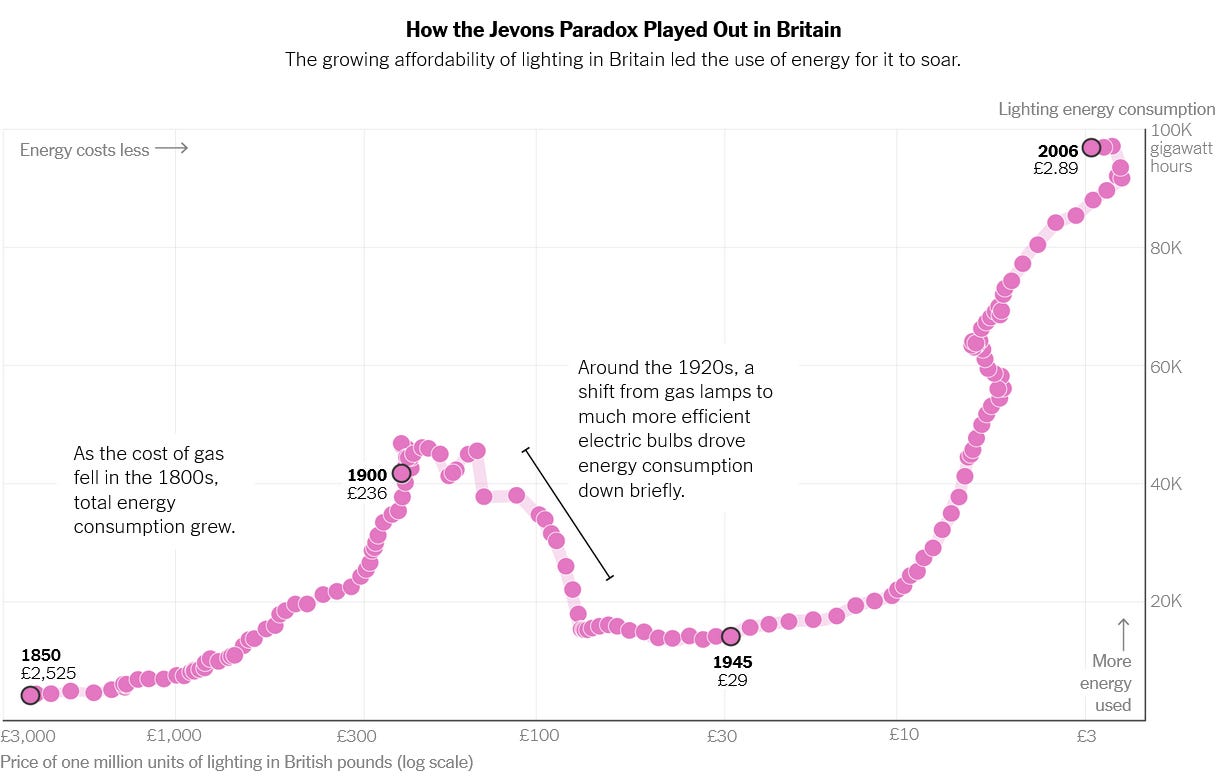
Do keep in mind that in most cases, the efficiency gains are so great that even our insatiable appetites and urges cannot negate them. For instance, as the efficiency of washing machines has improved, we don’t go nuts and start washing everything in sight. Refrigerators became dramatically more efficient. Households did not respond by acquiring a second fridge for the spiritual experience of opening it. Though my new refrigerator comes with an app so I can control it while I am in Fontainebleau.
Crucially, this is not the ordinary claim that a cheaper input gets used more. If the price of lighting declined because technology reduced costs and shifted the supply curve, the quantity demanded would rise through a simple movement along the demand curve. That is standard theory, not a paradox. Jevons’ paradox concerns a seemingly conservation technology - efficiency reduces input per unit of output - and asks why total input use can still rise.
What has elasticity got to do with it? Some assume this means that as the price of coal fell, people used more coal. And they talk about own price elasticity. But this is imprecise and indeed wrong.2 The Jevons mechanism does involve elasticity, but it is different. Total resource use = (resource per unit of activity) × (quantity of activity). Efficiency cuts the first term. But the rebound effects expand the second. Whether the second term offsets the first is governed by the elasticity of activity with respect to efficiency. If this elasticity is greater than one, the activity expands by more than efficiency improves, so total resource use rises.
For Jevons, a better steam engine reduces coal per horsepower-hour. But by making horsepower-hours cheaper, it increases demand for steam-powered activities. The relevant elasticity is therefore the percentage increase in coal-using activity divided by the percentage increase in coal efficiency. If a 10% improvement in efficiency raises coal-using activity by more than 10%, total coal use rises. That is the precise Jevons condition. And a rebound greater than 100% is called “backfire.”
Most empirical work finds some rebound, but not always backfire. The magnitude depends on the elasticity of demand for the energy service, the share of energy in the full cost of that service, saturation, complementary investments, and economy-wide growth effects. For example, washing machines account for a small share of water use, so we are unlikely to see a backfire effect here.
The modern AI argument directly borrows this idea. As the cost of a cognitive task (writing, coding, analysis, translation) falls toward the marginal cost of inference (zero?), the relevant question is not whether output per unit of compute rises (it plainly does), but the elasticity of task demand with respect to that falling effective price. Where this elasticity is high, total activity grows faster than per-task efficiency improves, and aggregate consumption of the underlying inputs - compute, electricity, and the labor that complements rather than substitutes for the model - rises rather than falls.
AI is an unusually interesting candidate for backfire, though not uniformly so. The effect is most likely when the cognitive component accounts for a large share of the full task cost, when model output can be used with little verification, and when efficiency gains pass through substantially to the effective price of the activity. A second, and more important, point is that cheap cognition does not merely intensify existing uses. It opens entirely new ones. Tasks that were previously uneconomic to perform at all, such as exhaustive document review, per-customer personalization, continuous code refactoring, or real-time translation at scale, become viable. Demand therefore shifts outward rather than simply moving along a fixed curve. This is the channel Jevons emphasized, which economists call the extensive margin. In those settings, an increase in demand for certain tasks can raise the demand for labor, rather than produce the job apocalypse that everyone keeps furrowing their brows about.3
In closing, to my current and past face-to-face students, if I kept you overlong and away from imbibing mead, I am sorry. But as a pope said:
A little learning is a dangerous thing;
Drink deep, or taste not the Pierian spring:
There shallow draughts intoxicate the brain,
And drinking largely sobers us again.
And yes, I am aware that probably none of you are reading this.
Here is an actual quote: “Jevons Paradox is the idea that when a technology makes something dramatically more efficient and cheaper, total usage of that thing often increases rather than decreases because lower costs unlock new demand and new uses.” This is like saying if electricity prices fell, we would use more electricity.
I am being quite loose here. The rebound will be smaller where trust, regulation, integration costs, legal exposure, or human judgment remain binding constraints. Of course, workflows will also change as some tasks are automated, some are augmented, and new ones emerge.
This was so good! :D
We didn’t get this either! We demand a rerun, over zoom 😛